AI Face Test

AI Face Test — independent reviews, comparisons, pricing and step-by-step guides on Aizhi.

  • Flo (app)

    Flo (app)

    Flo is a period-tracking app that provides menstrual cycle, ovulation and pregnancy tracking as well as perimenopause symptom tracking that was developed by Flo Health, Inc. It has over 380 million downloads worldwide and over 70 million monthly active users as of November 2024. In mid-2024, it reached unicorn status, and became Europe’s first femtech unicorn. The company has been accused of sharing users' sensitive health data with third parties without consent and misleading its users about data practices. == History == Flo Health, Inc. was co-founded in 2015 by Dmitry and Yuri Gurski, in Belarus. Their backgrounds helped build the first version of the software having experience in other fitness and health apps. Dmitry serves as the company's CEO. The company's development hubs are in London, Amsterdam and Vilnius. In 2016, the company raised $1 million in seed round funding from Flint Capital and Haxus Venture Fund. In 2017, Flo received an investment of $5 million from Flint Capital and model Natalia Vodianova with Vodianova helping develop an awareness campaign for the company. In 2018, Flo received an investment of $6 million from Mangrove Capital Partners, with participation from Flint Capital and Haxus, giving the company a valuation of $200 million. In mid-2019, Flo received an additional investment of $7.5 million led by Founders Fund. In 2020, the Federal Trade Commission alleged that Flo had misled users about its handling of health information to third parties including Google, Facebook, AppsFlyer, and Flurry since 2016. These allegations followed a 2019 report by The Wall Street Journal in reference to Facebook. The company reached a settlement in 2021 and was required to notify users of how their personal information was shared and obtain permission before any further information was shared. The agreement also required that Flo to undertake an independent privacy audit which it completed in March 2022. In early September 2021, Flo announced it closed $50M in a Series B financing, bringing the total capital raised to $65 million and company valuation to $800M led by VNV Global and Target Global. In March 2024, the Supreme Court of British Columbia certified a class action suit against Flo for sharing intimate data with Facebook and other third parties without user knowledge. In July 2024, Flo announced it raised more than $200M in Series C financing from General Atlantic bringing its valuation beyond $1 billion. As of November 2024, the app had over 380 million downloads world wide, and over 70 million monthly active users. In 2025, Flo adopted a data intelligence platform from Databricks to power its analytics and AI features, allowing users personalized cycle predictions. In 2025, a class action lawsuit in California was settled for $56 million with Flo paying $8 million and Google paying $48 million. == Features and privacy == Flo was initially created as a period and ovulation tracking application. It now provides reminders of upcoming menstrual cycles and a place to record various other health symptoms such as contraceptive methods, vaginal discharge (leukorrhea), water intake, pains, mood swings, and sexual activity. The application is available on iOS and Android. Flo is free to download and the free basic version gives you access to period and ovulation tracking and predictions, symptom tracking, cycle history, and anonymous mode. In Pregnancy mode, the app provides tracking features and educational material for pregnancy. In October 2023, Flo launched Flo for Partners, a feature that allows users to share their Flo data with their partner. In September 2022, as a response to Roe v. Wade being overturned, Flo sped up the release of a feature called "Anonymous Mode". Flo said this mode allows users to access the app without any personal identifiers such as name, email address, or technical identifiers being associated with their health data. Flo said it uses a technology called Oblivious HTTP to help protect user privacy in Anonymous Mode. == Recognition == Flo was named to Bloomberg’s Top 25 UK Startups to Watch for 2024. Flo's Anonymous Mode feature was recognized on both Fast Company's World Changing Ideas 2023 and TIME's Best Inventions List 2023. Flo is a CES 2019 Innovation Awards Honoree in the Software and Mobile Applications category.

    Read more →
  • GitHub Codespaces

    GitHub Codespaces

    GitHub Codespaces is a cloud-based online integrated development environment developed by GitHub. It allows users to create and manage development environments directly within the browser or through Visual Studio Code desktop. Codespaces is tightly integrated with GitHub repositories and enables on-demand coding, debugging, and testing in a full-featured development container hosted in the cloud. == Features == Instant development environments integrated with GitHub Browser-based and desktop access via Visual Studio Code Configurable Dockerfile or devcontainer.json environments Built-in support for GitHub Copilot, extensions, snippets, and SSH. == Licensing == GitHub Codespaces is proprietary software and available to GitHub users under various subscription plans. Codespaces includes a monthly usage quota for free tier users of 120 hours, and expanded access for GitHub education, Pro, Team, and GitHub Enterprise plans. == GitHub Classroom == GitHub Classroom is an educational tool developed by GitHub to streamline the process of managing programming assignments and coursework. Integrated with GitHub repositories, it allows instructors to distribute starter code, automate grading workflows, and track student progress. GitHub Classroom is widely used in computer science education and supports integration with GitHub Codespaces for cloud-based development environments. == Programming languages supported == == Extensions == Some of the popular extensions include:

    Read more →
  • List & Label

    List & Label

    List & Label is a professional reporting tool for software developers. It provides comprehensive design, print and export functions. The software component runs on Microsoft Windows and can be implemented in desktop, cloud and web applications. List & Label can be used to create user-defined dashboards, lists, invoices, forms and labels. It supports many development environments, frameworks and programming languages such as Microsoft Visual Studio, Embarcadero RAD Studio, .NET Framework, .NET Core, ASP.NET, C++, Delphi, Java, C Sharp and some more. List & Label either retrieves data from various sources via data binding, or works database independent. Reports are designed and created in the so-called List & Label Designer and then exported into a multitude of formats like PDF, Excel, XHTML and RTF. Since version 27 a web report designer for ASP.NET MVC is available. == History == The product was first released in 1992 by combit. The current version is 30. A new major version of List & Label is released every fall, usually in October. Updates are available several times a year via Service Pack. == Features == === Report Designer === The Designer enables users to graphically layout the report. It offers report objects such as tables, charts, crosstabs, gauges, HTML, conditionally formatted text, barcodes, matrix codes, and graphics, and is extensible using third-party add-ons. User applications can interact with the report via the programmable object model of the report. The real-time preview functionality allows users to view changes instantly. Usability features include layer and appearance management, enabling conditional logic to dynamically control the visibility of objects in reports. The Designer also supports the inclusion of multiple report containers in a single project, accommodating complex layouts such as parallel tables and charts. A formula wizard and support for scripting languages such as C# facilitate advanced calculations and logic. The Designer's object model (DOM) provides developers with the ability to modify layouts and behaviors programmatically. === Web Report Designer === The web report designer works browser-based and independent from printer drivers and spoolers - that makes deployments to the cloud easier. Just like the use of the Visual Studio deployment pipeline. === Data Sources === Depending on the programming language, the product offers automatic support for data sources: Databases such as Microsoft SQL Server, Oracle, MySQL, PostgreSQL, IBM Db2, SQLite, MariaDB, MongoDB, Cosmos DB XML data, CSV Business objects Data sources that can be accessed via OLE DB, ODBC or ADO.NET LINQ data and data from web services GraphQL Additionally, the product offers support for unbound data and can be extended to support other data sources via interfaces. === Output Options === Printer Image Formats (JPEG, BMP, EMF, TIFF, PNG, SVG, HEIF, WebP) Document Formats: PDF, PDF/A, Word (DOCX), Excel (XLS), PowerPoint (PPTX) HTML, XHTML, MHTML Barcodes Plain Text, RTF, CSV, JSON XML, ZIP, Email, JSON List & Label preview file === Target Audience === List & Label can be used in Windows development environments. While it competes most notably on the Microsoft .NET platform with other products such as Crystal Reports, SQL Server Reporting Services, ActiveReports, there are few competing products for other programming languages (e.g. Progress, Alaska Xbase++, Visual DataFlex). == Awards == Reader's Choice Award 2005–2008 Stevie Awards 2021: Best Technology for Data Visualization Top 100 Publisher Award Component Source 2013-2014, 2014-2015,2016, 2018, 2019, 2020, 2021, 2022

    Read more →
  • T Layout

    T Layout

    The T-Layout is an architectural and design concept for web applications, specifically tailored to improve the user experience on mobile devices. It features a horizontally scrollable container divided into three distinct sections, each spanning the full width of the screen, and was developed to optimise space usage and streamline navigation. == Background == The T-Layout introduces horizontal scrolling as a complementary method to the conventional pop-up-based navigation system in mobile web applications. In this layout, the central section which is visible by default upon accessing the application, facilitates the main content of a URL address and is flanked by two "helper" sections. This approach minimises the need for extensive user movements, in order to reach navigation controls typically located at the top of the screen. It is aimed at enhancing the user experience on mobile devices by providing an easier way to access essential content such as the main navigation, e-commerce related screens, or user account related information, ensuring that those elements are readily accessible while requiring minimal user effort. The T-Layout was first implemented by E (e-streetwear.com) in their mobile web app layout, and it was inspired by the interfaces of well-tested native mobile apps like Instagram and Revolut. A study titled "Mobile Navigation and User Preferences Survey" indicated a preference among mobile app users for one-handed usage, primarily navigating with their thumb. These insights led to the T-Layout Experiment, which compared the efficiency of using swipe gestures to access navigational elements against reaching traditional navigation controls. == Development history == It was first released as the mobile layout of E in early 2023. It was originally developed based on six principles: user-centric functionality, lightweight filesize, HTML and CSS implementation with minimal or no use of JavaScript required, suitable both for browser and server-rendering architectures, intuitive design, and improved SEO. The development of the T-Layout was driven by the necessity for more ergonomic and user-friendly interfaces in mobile web applications. Its design, reminiscent of the letter 'T', emerged as a solution to several usability challenges mobile device users face, emphasising ease of access and efficient screen space utilisation. In July 2023, E formalised the concept and its technical specifications, introducing it to the web design and development community. In October 2023 the "Mobile Navigation and User Preferences Survey" was conducted, establishing that the vast majority of individuals prefer to use mobile applications by holding the phone in a one-handed grip, utilising only the thumb for gestures when possible. The subsequent "T-Layout Experiment", designed to measure the time in seconds and the distance (user effort) in pixels, required to access navigational elements by traditionally tapping on fixed-positioned controls compared to swiping anywhere on the screen. The results proved that swipe gestures require less time and much less effort. == Styling and features == The main characteristic of the T-Layout is its horizontal scrolling feature, which can improve navigation efficiency while preserving the functionality of traditionally structured user interfaces. Its Implementation can be achieved with a combination of HTML and styling with CSS as well as precompiled Scss and Sass, CSS-in-JS, and styled JSX. It can be either a purely HTML/CSS solution but JavaScript can be utilised as well to add more specific functionalities, while It can be implemented to both existing and new applications. Its application in server-side rendering architectures will ensure that all its underlying principles apply. Although principally each section in the layout has a distinct role and facilitates specific types of content, the T-Layout as a concept is versatile, and it is adaptable allowing modifications in the layout or how it's implemented to cater to the specific needs of different applications.

    Read more →
  • Automaton

    Automaton

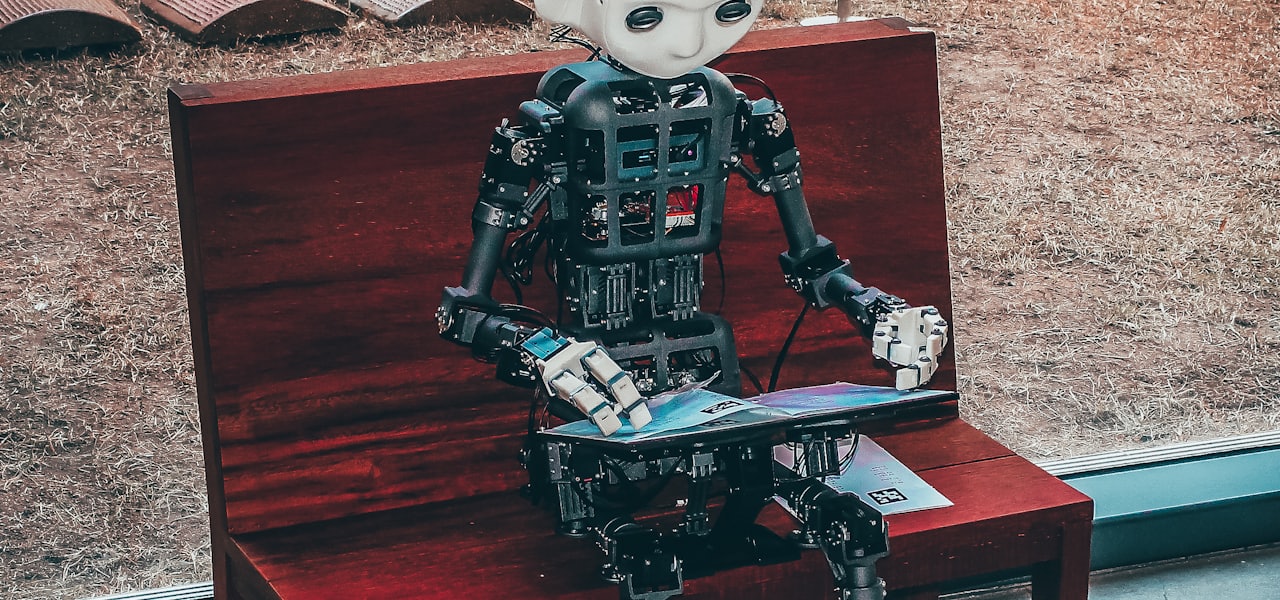
    An automaton ( ; pl.: automata or automatons) is a relatively self-operating machine or control mechanism designed to automatically follow a sequence of operations or respond to predetermined instructions. Some automata, such as bellstrikers in mechanical clocks, are designed to give the illusion to the casual observer that they are operating under their own power or will, like a mechanical robot. The term has long been commonly associated with automated puppets that resemble moving humans or animals, built to impress and/or to entertain people. Animatronics are a modern type of automata with electronics, often used for the portrayal of characters or creatures in films and in theme park attractions. == Etymology == The word automaton is the latinization of the Ancient Greek automaton (αὐτόματον), which means "acting of one's own will". It was first used by Homer to describe an automatic door opening, or automatic movement of wheeled tripods. It is more often used to describe non-electronic moving machines, especially those that have been made to resemble human or animal actions, such as the jacks on old public striking clocks, or the cuckoo and any other animated figures on a cuckoo clock. == History == === Ancient === There are many examples of automata in Greek mythology: Hephaestus created automata for his workshop; Talos was an artificial man of bronze; King Alkinous of the Phaiakians employed gold and silver watchdogs. According to Aristotle, Daedalus used quicksilver to make his wooden statue of Aphrodite move. In other Greek legends he used quicksilver to install voice in his moving statues. The automata in the Hellenistic world were intended as tools, toys, religious spectacles, or prototypes for demonstrating basic scientific principles. Numerous water-powered automata were built by Ktesibios, a Greek inventor and the first head of the Great Library of Alexandria; for example, he "used water to sound a whistle and make a model owl move. He had invented the world's first 'cuckoo clock'". This tradition continued in Alexandria with inventors such as the Greek mathematician Hero of Alexandria (sometimes known as Heron), whose writings on hydraulics, pneumatics, and mechanics described siphons, a fire engine, a water organ, the aeolipile, and a programmable cart. Philo of Byzantium was famous for his inventions. Complex mechanical devices are known to have existed in Hellenistic Greece, though the only surviving example is the Antikythera mechanism, the earliest known analog computer. The clockwork is thought to have come originally from Rhodes, where there was apparently a tradition of mechanical engineering; the island was renowned for its automata; to quote Pindar's seventh Olympic Ode: The animated figures stand Adorning every public street And seem to breathe in stone, or move their marble feet. However, the information gleaned from recent scans of the fragments indicate that it may have come from the colonies of Corinth in Sicily and implies a connection with Archimedes. According to Jewish legend, King Solomon used his wisdom to design a throne with mechanical animals which hailed him as king when he ascended it; upon sitting down an eagle would place a crown upon his head, and a dove would bring him a Torah scroll. It is also said that when King Solomon stepped upon the throne, a mechanism was set in motion. As soon as he stepped upon the first step, a golden ox and a golden lion each stretched out one foot to support him and help him rise to the next step. On each side, the animals helped the King up until he was comfortably seated upon the throne. In ancient China, a curious account of automata is found in the Lie Zi text, believed to have originated around 400 BCE and compiled around the fourth century CE. Within it there is a description of a much earlier encounter between King Mu of Zhou (1023–957 BCE) and a mechanical engineer known as Yan Shi, an 'artificer'. The latter proudly presented the king with a very realistic and detailed life-size, human-shaped figure of his mechanical handiwork: The king stared at the figure in astonishment. It walked with rapid strides, moving its head up and down, so that anyone would have taken it for a live human being. The artificer touched its chin, and it began singing, perfectly in tune. He touched its hand, and it began posturing, keeping perfect time...As the performance was drawing to an end, the robot winked its eye and made advances to the ladies in attendance, whereupon the king became incensed and would have had Yen Shih [Yan Shi] executed on the spot had not the latter, in mortal fear, instantly taken the robot to pieces to let him see what it really was. And, indeed, it turned out to be only a construction of leather, wood, glue and lacquer, variously coloured white, black, red and blue. Examining it closely, the king found all the internal organs complete—liver, gall, heart, lungs, spleen, kidneys, stomach and intestines; and over these again, muscles, bones and limbs with their joints, skin, teeth and hair, all of them artificial...The king tried the effect of taking away the heart, and found that the mouth could no longer speak; he took away the liver and the eyes could no longer see; he took away the kidneys and the legs lost their power of locomotion. The king was delighted. Other notable examples of automata include Archytas' dove, mentioned by Aulus Gellius. Similar Chinese accounts of flying automata are written of the 5th century BC Mohist philosopher Mozi and his contemporary Lu Ban, who made artificial wooden birds (ma yuan) that could successfully fly according to the Han Fei Zi and other texts. === Medieval === The manufacturing tradition of automata continued in the Greek world well into the Middle Ages. On his visit to Constantinople in 949 ambassador Liutprand of Cremona described automata in the emperor Theophilos' palace, including "lions, made either of bronze or wood covered with gold, which struck the ground with their tails and roared with open mouth and quivering tongue," "a tree of gilded bronze, its branches filled with birds, likewise made of bronze gilded over, and these emitted cries appropriate to their species" and "the emperor's throne" itself, which "was made in such a cunning manner that at one moment it was down on the ground, while at another it rose higher and was to be seen up in the air." Similar automata in the throne room (singing birds, roaring and moving lions) were described by Luitprand's contemporary the Byzantine emperor Constantine Porphyrogenitus, in his book De Ceremoniis (Perì tês Basileíou Tákseōs). In the mid-8th century, the first wind powered automata were built: "statues that turned with the wind over the domes of the four gates and the palace complex of the Round City of Baghdad". The "public spectacle of wind-powered statues had its private counterpart in the 'Abbasid palaces where automata of various types were predominantly displayed." Also in the 8th century, the Muslim alchemist, Jābir ibn Hayyān (Geber), included recipes for constructing artificial snakes, scorpions, and humans that would be subject to their creator's control in his coded Book of Stones. In 827, Abbasid caliph al-Ma'mun had a silver and golden tree in his palace in Baghdad, which had the features of an automatic machine. There were metal birds that sang automatically on the swinging branches of this tree built by Muslim inventors and engineers. The Abbasid caliph al-Muqtadir also had a silver and golden tree in his palace in Baghdad in 917, with birds on it flapping their wings and singing. In the 9th century, the Banū Mūsā brothers invented a programmable automatic flute player and which they described in their Book of Ingenious Devices. Al-Jazari described complex programmable humanoid automata amongst other machines he designed and constructed in the Book of Knowledge of Ingenious Mechanical Devices in 1206. His automaton was a boat with four automatic musicians that floated on a lake to entertain guests at royal drinking parties. His mechanism had a programmable drum machine with pegs (cams) that bump into little levers that operate the percussion. The drummer could be made to play different rhythms and drum patterns if the pegs were moved around. Al-Jazari constructed a hand washing automaton first employing the flush mechanism now used in modern toilets. It features a female automaton standing by a basin filled with water. When the user pulls the lever, the water drains and the automaton refills the basin. His "peacock fountain" was another more sophisticated hand washing device featuring humanoid automata as servants who offer soap and towels. Mark E. Rosheim describes it as follows: "Pulling a plug on the peacock's tail releases water out of the beak; as the dirty water from the basin fills the hollow base a float rises and actuates a linkage which makes a servant figure appear from behind a door under the peacock and offer soap.

    Read more →
  • Box blur

    Box blur

    A box blur (also known as a box linear filter) is a spatial domain linear filter in which each pixel in the resulting image has a value equal to the average value of its neighboring pixels in the input image. It is a form of low-pass ("blurring") filter. A 3 by 3 box blur ("radius 1") can be written as matrix 1 9 [ 1 1 1 1 1 1 1 1 1 ] . {\displaystyle {\frac {1}{9}}{\begin{bmatrix}1&1&1\\1&1&1\\1&1&1\end{bmatrix}}.} Due to its property of using equal weights, it can be implemented using a much simpler accumulation algorithm, which is significantly faster than using a sliding-window algorithm. Box blurs are frequently used to approximate a Gaussian blur. By the central limit theorem, repeated application of a box blur will approximate a Gaussian blur. In the frequency domain, a box blur has zeros and negative components. That is, a sine wave with a period equal to the size of the box will be blurred away entirely, and wavelengths shorter than the size of the box may be phase-reversed, as seen when two bokeh circles touch to form a bright spot where there would be a dark spot between two bright spots in the original image. == Extensions == Gwosdek, et al. has extended Box blur to take a fractional radius: the edges of the 1-D filter are expanded with a fraction. It makes slightly better gaussian approximation possible due to the elimination of integer-rounding error. Mario Klingemann has a "stack blur" that tries to better emulate gaussian's look in one pass by stacking weights: 1 9 [ 1 2 3 2 1 ] {\displaystyle {\frac {1}{9}}{\begin{bmatrix}1&2&3&2&1\end{bmatrix}}} The triangular impulse response it forms decomposes to two rounds of box blur. Stacked Integral Image by Bhatia et al. takes the weighted average of a few box blurs to fit the gaussian response curve. == Implementation == The following pseudocode implements a 3x3 box blur. The example does not handle the edges of the image, which would not fit inside the kernel, so that these areas remain unblurred. In practice, the issue is better handled by: Introducing an alpha channel to represent the absence of colors; Extending the boundary by filling in values, ranked by quality: Fill in a mirrored image at the border Fill in a constant color extending from the last pixel Pad in a fixed color A number of optimizations can be applied when implementing the box blur of a radius r and N pixels: The box blur is a separable filter, so that only two 1D passes of averaging 2 r + 1 pixels will be needed, one horizontal and one vertical, for each pixel. This lowers the complexity from O(Nr2) to O(Nr). In digital signal processing terminology, each pass is a moving-average filter. Accumulation. Instead of discarding the sum for each pixel, the algorithm re-uses the previous sum, and updates it by subtracting away the old pixel and adding the new pixel in the blurring range. A summed-area table can be used similarly. This lowers the complexity from O(Nr) to O(N). When being used in multiple passes to approximate a Gaussian blur, the cascaded integrator–comb filter construction allows for doing the equivalent operation in a single pass.

    Read more →
  • Color space

    Color space

    A color space is a specific organization of colors. In combination with color profiling supported by various physical devices, it supports reproducible representations of color – whether such representation entails an analog or a digital representation. A color space may be arbitrary, i.e. with physically realized colors assigned to a set of physical color swatches with corresponding assigned color names (including discrete numbers in – for example – the Pantone collection), or structured with mathematical rigor (as with the NCS System, Adobe RGB and sRGB). A "color space" is a useful conceptual tool for understanding the color capabilities of a particular device or digital file. When trying to reproduce color on another device, color spaces can show whether shadow/highlight detail and color saturation can be retained, and by how much either will be compromised. A "color model" is an abstract mathematical model describing the way colors can be represented as tuples of numbers (e.g. triples in RGB or quadruples in CMYK); however, a color model with no associated mapping function to an absolute color space is a more or less arbitrary color system with no connection to any globally understood system of color interpretation. Adding a specific mapping function between a color model and a reference color space establishes within the reference color space a definite "footprint", known as a gamut, and for a given color model, this defines a color space. For example, Adobe RGB and sRGB are two different absolute color spaces, both based on the RGB color model. When defining a color space, the usual reference standard is the CIELAB or CIEXYZ color spaces, which were specifically designed to encompass all colors the average human can see. Since "color space" identifies a particular combination of the color model and the mapping function, the word is often used informally to identify a color model. However, even though identifying a color space automatically identifies the associated color model, this usage is incorrect in a strict sense. For example, although several specific color spaces are based on the RGB color model, there is no such thing as the singular RGB color space. == History == In 1802, Thomas Young postulated the existence of three types of photoreceptors (now known as cone cells) in the eye, each of which was sensitive to a particular range of visible light. Hermann von Helmholtz developed the Young–Helmholtz theory further in 1850: that the three types of cone photoreceptors could be classified as short-preferring (blue), middle-preferring (green), and long-preferring (red), according to their response to the wavelengths of light striking the retina. The relative strengths of the signals detected by the three types of cones are interpreted by the brain as a visible color. But it is not clear that they thought of colors as being points in color space. The color-space concept was likely due to Hermann Grassmann, who developed it in two stages. First, he developed the idea of vector space, which allowed the algebraic representation of geometric concepts in n-dimensional space. Fearnley-Sander (1979) describes Grassmann's foundation of linear algebra as follows: The definition of a linear space (vector space)... became widely known around 1920, when Hermann Weyl and others published formal definitions. In fact, such a definition had been given thirty years previously by Peano, who was thoroughly acquainted with Grassmann's mathematical work. Grassmann did not put down a formal definition—the language was not available—but there is no doubt that he had the concept. With this conceptual background, in 1853, Grassmann published a theory of how colors mix; it and its three color laws are still taught, as Grassmann's law. As noted first by Grassmann... the light set has the structure of a cone in the infinite-dimensional linear space. As a result, a quotient set (with respect to metamerism) of the light cone inherits the conical structure, which allows color to be represented as a convex cone in the 3- D linear space, which is referred to as the color cone. == Examples == Colors can be created in printing with color spaces based on the CMYK color model, using the subtractive primary colors of pigment (cyan, magenta, yellow, and key [black]). To create a three-dimensional representation of a given color space, we can assign the amount of magenta color to the representation's X axis, the amount of cyan to its Y axis, and the amount of yellow to its Z axis. The resulting 3-D space provides a unique position for every possible color that can be created by combining those three pigments. Colors can be created on computer monitors with color spaces based on the RGB color model, using the additive primary colors (red, green, and blue). A three-dimensional representation would assign each of the three colors to the X, Y, and Z axes. Colors generated on a given monitor will be limited by the reproduction medium, such as the phosphor (in a CRT monitor) or filters and backlight (LCD monitor). Another way of creating colors on a monitor is with an HSL or HSV color model, based on hue, saturation, brightness (value/lightness). With such a model, the variables are assigned to cylindrical coordinates. Many color spaces can be represented as three-dimensional values in this manner, but some have more, or fewer dimensions, and some, such as Pantone, cannot be represented in this way at all. == Conversion == Color space conversion is the translation of the representation of a color from one basis to another. This typically occurs in the context of converting an image that is represented in one color space to another color space, the goal being to make the translated image look as similar as possible to the original. == RGB density == The RGB color model is implemented in different ways, depending on the capabilities of the system used. The most common incarnation in general use as of 2021 is the 24-bit implementation, with 8 bits, or 256 discrete levels of color per channel. Any color space based on such a 24-bit RGB model is thus limited to a range of 256×256×256 ≈ 16.7 million colors. Some implementations use 16 bits per component for 48 bits total, resulting in the same gamut with a larger number of distinct colors. This is especially important when working with wide-gamut color spaces (where most of the more common colors are located relatively close together), or when a large number of digital filtering algorithms are used consecutively. The same principle applies for any color space based on the same color model, but implemented at different bit depths. == Lists == CIE 1931 XYZ color space was one of the first attempts to produce a color space based on measurements of human color perception (earlier efforts were by James Clerk Maxwell, König & Dieterici, and Abney at Imperial College) and it is the basis for almost all other color spaces. The CIERGB color space is a linearly-related companion of CIE XYZ. Additional derivatives of CIE XYZ include the CIELUV, CIEUVW, and CIELAB. === Generic === RGB uses additive color mixing, because it describes what kind of light needs to be emitted to produce a given color. RGB stores individual values for red, green and blue. RGBA is RGB with an additional channel, alpha, to indicate transparency. Common color spaces based on the RGB model include sRGB, Adobe RGB, ProPhoto RGB, scRGB, and CIE RGB. CMYK uses subtractive color mixing used in the printing process, because it describes what kind of inks need to be applied so the light reflected from the substrate and through the inks produces a given color. One starts with a white substrate (canvas, page, etc.), and uses ink to subtract color from white to create an image. CMYK stores ink values for cyan, magenta, yellow and black. There are many CMYK color spaces for different sets of inks, substrates, and press characteristics (which change the dot gain or transfer function for each ink and thus change the appearance). YIQ was formerly used in NTSC (North America, Japan and elsewhere) television broadcasts for historical reasons. This system stores a luma value roughly analogous to (and sometimes incorrectly identified as) luminance, along with two chroma values as approximate representations of the relative amounts of blue and red in the color. It is similar to the YUV scheme used in most video capture systems and in PAL (Australia, Europe, except France, which uses SECAM) television, except that the YIQ color space is rotated 33° with respect to the YUV color space and the color axes are swapped. The YDbDr scheme used by SECAM television is rotated in another way. YPbPr is a scaled version of YUV. It is most commonly seen in its digital form, YCbCr, used widely in video and image compression schemes such as MPEG and JPEG. xvYCC is an international digital video color space standard published by the IEC (IEC 61966-2-4). It is based on the ITU BT.601 and BT.709

    Read more →
  • Dropbox Paper

    Dropbox Paper

    Dropbox Paper, or simply Paper, is a collaborative document-editing service developed by Dropbox. Originating from the company's acquisition of document collaboration company Hackpad in April 2014, Dropbox Paper was officially announced in October 2015, and launched in January 2017. It offers a web application, as well as mobile apps for Android and iOS. Dropbox Paper was described in the official announcement post as "a flexible workspace that brings people and ideas together. With Paper, teams can create, review, revise, manage, and organize — all in shared documents". Reception of Dropbox Paper has been mixed. Critics praised collaboration functionality, including content available immediately, the ability to mention specific collaborators, assign tasks, write comments, as well as editing attribution, and revision history. It received particular praise for its support for rich media from a variety of sources, with one reviewer noting that the Paper's support for rich media exceeds the capabilities of most of its competitors. However, it was criticized for a lack of formatting options and editing features. While the user interface was liked for being minimal, reviewers cited the lack of a fixed formatting bar and missing features present in competitors' products as making Dropbox Paper seem like a "light" tool. == History == Dropbox acquired document collaboration company Hackpad in April 2014. A year later, Dropbox launched a Dropbox Notes note-taking product in beta testing phase. Dropbox Paper was officially announced on October 15, 2015, followed by an open beta and release of mobile Android and iOS apps in August 2016. Dropbox Paper was officially released on January 30, 2017. == Reception == In a comparison between Dropbox Paper and Evernote, PC World's Michael Ansaldo wrote that "With its emphasis on document creation, you might expect formatting to be front and center in Dropbox Paper. That's not the case." Ansaldo noted the lack of a "fixed formatting toolbar as you'd find in Evernote or a word processor like Google Docs or Microsoft Word. Instead, the text editor appears as a floating ribbon only when you highlight selected text." The only formatting options available for emphasis were bolding, strikethrough, bulleted and numbered lists, and H1 and H2 tags. Users can also add links, convert text to checklists, and add comments. Ansaldo wrote that "Both Evernote and Dropbox Paper make it easy to add images to a document", but also noted that "Dropbox Paper doesn't support any image editing". Paper supports rich media, and users can "add rich content to your document just by pasting a link to the file. In addition to Dropbox, Paper supports media from a variety of popular services including YouTube, Spotify, Vimeo, SoundCloud, Facebook, and Google's productivity suite. Once the file appears, you can delete the link for a cleaner display." To start working with other people, Paper "allows you to invite people via email from within a document", with sharing options for who can view the link (anyone with the link or just the invited person), and action permissions (edit or only comment). Regarding collaboration, Ansaldo wrote that "Creative collaboration is Paper’s marquee feature, and it provides a variety of ways to work effectively with others in real time". Users can "make any content immediately visible and accessible to a specific collaborator with "@mentions"", and "You can also use @mentions to create and assign task lists within a document." Paper also "boasts essential collaboration tools including comments, editing attribution, and revision history." Writing for TechRadar, John Brandon wrote that Dropbox Paper "might be a 'light' tool for now without the extensive templates of Microsoft Office or the integration with other apps in the Zoho suite, but it does work well with the Dropbox storage service that's so popular with office workers these days." Kyle Wiggers of Digital Trends wrote that Paper is "all about minimizing distractions. Its interface is quite literally a big, blank canvas on which you tap out your agenda. You can organize notes by title and create to-do lists, but even basic formatting tools are obscured from view", noting Paper's "floating box above words and phrases highlighted by your cursor". Wiggers stated that "Paper is not a to-do organizer", but that it's "well suited to the purpose thanks to a bevy of labor-saving conveniences", highlighting that Paper "supports more media than most of its to-do and note-taking counterparts". He praised the collaboration tools, writing that they "are as extensive as you'd hope, and then some", citing its invitation system with permission controls, lists of changes and revision history, comment and chat support, and "perhaps best of all", the ability to assign tasks with a "@" mention. Business Insider's Alex Heath praised that "Paper's interface is spotless and friendly to write in. You don't feel overwhelmed with formatting options", but criticized the available features, writing that "Google Docs is much more full-featured in the formatting department, so Paper has some catching up to do if it wants to be on par with the competition". Writing for The Verge, Casey Newton praised Paper's handling of rich media, complimenting it for being "great", and added that "I imagine that creative types who work on teams will appreciate having rich media embedded in the documents they're working on rather than in a series of infinite tabs".

    Read more →
  • Hallucination (artificial intelligence)

    Hallucination (artificial intelligence)

    In the field of artificial intelligence (AI), a hallucination or artificial hallucination (also called bullshitting, confabulation, or delusion) is a response generated by AI that contains false or misleading information presented as fact. This term draws a loose analogy with human psychology, where a hallucination typically involves false percepts. For example, a chatbot powered by large language models (LLMs), like ChatGPT, may embed plausible-sounding random falsehoods within its generated content. Detecting and mitigating errors and hallucinations pose significant challenges for practical deployment and reliability of LLMs in high-stakes scenarios, such as chip design, supply chain logistics, and medical diagnostics. Some software engineers and statisticians have criticized the specific term "AI hallucination" for unreasonably anthropomorphizing computers. Symbolic artificial intelligence models generally do not produce hallucinations, unlike large language models. == Term == === Origin === Since the 1980s, the term "hallucination" has been used in computer vision with a positive connotation to describe the process of adding detail to an image. For example, the task of generating high-resolution face images from low-resolution inputs is called face hallucination. The first documented use of the term "hallucination" in this sense is in the PhD thesis of Eric Mjolsness in 1986. A notable work is the face hallucination algorithm by Simon Baker and Takeo Kanade published in 1999. In the 2000s, hallucinations were described in statistical machine translation as a failure mode. Since the 2010s, the term has undergone a semantic shift to signify the generation of factually incorrect or misleading outputs by AI systems in tasks like machine translation and object detection. In 2015, hallucinations were identified in visual semantic role labeling tasks by Saurabh Gupta and Jitendra Malik. In 2015, computer scientist Andrej Karpathy used the term "hallucinated" in a blog post to describe his recurrent neural network (RNN) language model generating an incorrect citation link. In 2017, Google researchers used the term to describe the responses generated by neural machine translation (NMT) models when they are not related to the source text, and in 2018, the term was used in computer vision to describe instances where non-existent objects are erroneously detected because of adversarial attacks. In July 2021, Meta warned during its release of BlenderBot 2 that the system is prone to "hallucinations", which Meta defined as "confident statements that are not true". Following OpenAI's ChatGPT release in beta version in November 2022, some users complained that such chatbots often seem to pointlessly embed plausible-sounding random falsehoods within their generated content. Many news outlets, including The New York Times, started to use the term "hallucinations" to describe these models' frequently incorrect or inconsistent responses. In 2023, the Cambridge dictionary updated its definition of hallucination to include this new sense specific to the field of AI. Some researchers have highlighted a lack of consistency in how the term is used, but also identified several alternative terms in the literature, such as confabulations, fabrications, and factual errors. === Definitions and alternatives === Uses, definitions and characterizations of the term "hallucination" in the context of LLMs include: "a tendency to invent facts in moments of uncertainty" (OpenAI, May 2023) "a model's logical mistakes" (OpenAI, May 2023) "fabricating information entirely, but behaving as if spouting facts" (CNBC, May 2023) "making up information" (The Verge, February 2023) "probability distributions" (in scientific contexts) Journalist Benj Edwards, in Ars Technica, writes that the term "hallucination" is controversial, but that some form of metaphor remains necessary; Edwards suggests "confabulation" as an analogy for processes that involve "creative gap-filling". In July 2024, a White House report on fostering public trust in AI research mentioned hallucinations only in the context of reducing them. Notably, when acknowledging David Baker's Nobel Prize-winning work with AI-generated proteins, the Nobel committee avoided the term entirely, instead referring to "imaginative protein creation". Hicks, Humphries, and Slater, in their article in Ethics and Information Technology, argue that the output of LLMs is "bullshit" under Harry Frankfurt's definition of the term, and that the models are "in an important way indifferent to the truth of their outputs", with true statements only accidentally true, and false ones accidentally false. Some researchers also use the derogatory term "botshit", often referring to uncritical use of AI. === Criticism === In the scientific community, some researchers avoid the term "hallucination", seeing it as potentially misleading. It has been criticized by Usama Fayyad, executive director of the Institute for Experimental Artificial Intelligence at Northeastern University, on the grounds that it misleadingly personifies large language models and is vague. Mary Shaw said, "The current fashion for calling generative AI's errors 'hallucinations' is appalling. It anthropomorphizes the software, and it spins actual errors as somehow being idiosyncratic quirks of the system even when they're objectively incorrect." In Salon, statistician Gary Smith argues that LLMs "do not understand what words mean" and consequently that the term "hallucination" unreasonably anthropomorphizes the machine. Murray Shanahan argues that anthropomorphic framing of LLM capabilities, including terms like "hallucination", encourages users and researchers to attribute cognitive processes to systems that operate through statistical pattern completion, and advocates for more careful linguistic practices when discussing LLM behavior. Kristina Šekrst argues that applying psychological vocabulary to LLM outputs obscures the difference between the appearance of mental properties and their genuine presence. Förster & Skop assert that tech companies use the hallucination metaphor to anthropomorphize models and deflect responsibility for non-factual outputs. Some see the AI outputs not as illusory but as prospective—that is, having some chance of being true, similar to early-stage scientific conjectures. The term has also been criticized for its association with psychedelic drug experiences. == In natural language generation == In natural language generation, there are several reasons why natural language models hallucinate: === Hallucination from data === Hallucinations can stem from incomplete, inaccurate or unrepresentative data sets. === Modeling-related causes === The pre-training of generative pretrained transformers (GPT) involves predicting the next word. It incentivizes GPT models to "give a guess" about what the next word is, even when they lack information. Some researchers take an anthropomorphic perspective and posit that hallucinations arise from a tension between novelty and usefulness. For instance, Amabile and Pratt define human creativity as the production of novel and useful ideas. By extension, a focus on novelty in machine creativity can lead to the production of original but inaccurate responses—that is, falsehoods—whereas a focus on usefulness may result in memorized content lacking originality. By 2022, newspapers such as The New York Times expressed concern that, as the adoption of bots based on large language models continued to grow, unwarranted user confidence in bot output could lead to problems. === Interpretability research === In 2025, interpretability research by Anthropic on the LLM Claude identified internal circuits that cause it to decline to answer questions unless it knows the answer. By default, the circuit is active and the LLM doesn't answer. When the LLM has sufficient information, these circuits are inhibited and the LLM answers the question. Hallucinations were found to occur when this inhibition happens incorrectly, such as when Claude recognizes a name but lacks sufficient information about that person, causing it to generate plausible but untrue responses. === Examples === On 15 November 2022, researchers from Meta AI published Galactica, designed to "store, combine and reason about scientific knowledge". Content generated by Galactica came with the warning: "Outputs may be unreliable! Language Models are prone to hallucinate text." In one case, when asked to draft a paper on creating avatars, Galactica cited a fictitious paper from a real author who works in the relevant area. Meta withdrew Galactica on 17 November due to offensiveness and inaccuracy. OpenAI's ChatGPT, released in beta version to the public on November 30, 2022, was based on the foundation model GPT-3.5 (a revision of GPT-3). Professor Ethan Mollick of Wharton called it an "omniscient, eager-to-please intern who sometimes lies to you". Data scientist Teresa Kuba

    Read more →
  • FreshBooks

    FreshBooks

    FreshBooks is accounting software operated by 2ndSite Inc. primarily for small and medium-sized businesses. It is a web-based software as a service (SaaS) model, that can be accessed through a desktop or mobile device. The company was founded in 2003 and is based in Toronto, Canada. == History == FreshBooks was founded in 2004 by Mike McDerment, Levi Cooperman, and Joe Sawada in Toronto, Ontario. McDerment incorporated a second company, BillSpring in January 2015 to work on new product development. It was rolled back into FreshBooks as an updated interface in 2016. Initially FreshBooks functioned like an electronic invoicing program targeting IT professionals. After the release of the new interface, the initial release of FreshBooks was referred to as "FreshBooks Classic." FreshBooks Classic was discontinued in 2022 after migrating users to the new platform. FreshBooks Classic's front-end application was built in PHP, and the backend services were built in Python while the new FreshBooks uses the same backend services with a JavaScript single-page application. == Product == FreshBooks is a subscription-based accounting software platform that provides features such as invoicing, accounts payable, expense and time tracking, retainers, fixed asset depreciation, purchase orders, payroll integrations, mileage tracking, double-entry accounting, and standard business reporting. Financial data is stored in the cloud on a unified ledger, enabling access from desktop and mobile devices. The platform includes a free API for integration with external applications and supports multiple tax rates and currencies. It also offers project management and payroll functionalities. Pricing is based on a recurring monthly fee. FreshBooks supports country-specific tax calculations, including GST and HST in Canada, sales taxes in the United States, and MTD compliance in the UK. == Operations == FreshBooks has its headquarters in Toronto, Canada with operations in North America, Europe and Australia. Founder Mike McDerment was the chief executive officer of the company from 2003 until 2021, when he stepped down and was replaced by Don Epperson, but stayed as the executive chair. Don Epperson had previously joined FreshBooks as executive director in 2019. == Funding == FreshBooks was initially self-funded. In 2014, the company raised a Series A venture investment of $30 million led by the venture capital firm Oak Investment Partners, with participation by Georgian Partners and Atlas Venture. In 2017, FreshBooks announced that it raised another $43 million in funding from Accomplice, Georgian Partners and Oak Investment Partners. On August 10, 2021, FreshBooks announced that it had secured $80.75 million in Series E funding and $50 million in debt financing. FreshBooks also reached a valuation of more than $1 billion.

    Read more →
  • Discrete skeleton evolution

    Discrete skeleton evolution

    Discrete Skeleton Evolution (DSE) describes an iterative approach to reducing a morphological or topological skeleton. It is a form of pruning in that it removes noisy or redundant branches (spurs) generated by the skeletonization process, while preserving information-rich "trunk" segments. The value assigned to individual branches varies from algorithm to algorithm, with the general goal being to convey the features of interest of the original contour with a few carefully chosen lines. Usually, clarity for human vision (aka. the ability to "read" some features of the original shape from the skeleton) is valued as well. DSE algorithms are distinguished by complex, recursive decision-making processes with high computational requirements. Pruning methods such as by structuring element (SE) convolution and the Hough transform are general purpose algorithms which quickly pass through an image and eliminate all branches shorter than a given threshold. DSE methods are most applicable when detail retention and contour reconstruction are valued. == Methodology == === Pre-processing === Input images will typical contain more data than is necessary to generate an initial skeleton, and thus must be reduced in some way. Reducing the resolution, converting to grayscale, and then binary by masking or thresholding are common first steps. Noise removal may occur before and/or after converting an image to binary. Morphological operations such as closing, opening, and smoothing of the binary image may also be part of pre-processing. Ideally, the binarized contour should be as noise-free as possible before the skeleton is generated. === Skeletonization === DSE techniques may be applied to an existing skeleton or incorporated as part of the skeleton growing algorithm. Suitable skeletons may be obtained using a variety of methods: Thinning algorithms, such as the Grassfire transform Voronoi diagram Medial Axis Transform or Symmetry Axis Transform Distance Mapping === Significance Measures === DSE and related methods remove entire spurious branches while leaving the main trunk intact. The intended result is typically optimized for visual clarity and retention of information, such that the original contour can be reconstructed from the fully pruned skeleton. The value of various properties must be weighted by the application, and improving the efficiency is an ongoing topic of research in computer vision and image processing. Some significance measures include: Discrete Bisector Function Contour length Bending Potential Ratio Discrete Curve Evolution === Iteration === Each branch is evaluated during a pass through the skeletonized image according to the specific algorithm being used. Low value branches are removed and the process is repeated until a desired threshold of simplicity is reached. === Reconstruction === If all points on the output skeleton are the center points of maximal disks of the image and the radius information is retained, a contour image can be reconstructed == Applications == === Handwriting and text parsing === Variability in hand-written text is an ongoing challenge, simplification makes it somewhat easier for computer vision algorithms to make judgements about intended characters. === Soft body classification (animals) === The maximal disks centered on the skeleton imply roughly spherical masses, the features of the extracted skeleton are relatively unchanged even as the soft body deforms or self-occludes. Skeleton information is one facet of determining whether two animals are the "same" some way, though it must usually be paired with another technique to effectively identify a target. === Medical uses === Investigation of organs, tissue damage and deformation caused by disease.

    Read more →
  • List & Label

    List & Label

    List & Label is a professional reporting tool for software developers. It provides comprehensive design, print and export functions. The software component runs on Microsoft Windows and can be implemented in desktop, cloud and web applications. List & Label can be used to create user-defined dashboards, lists, invoices, forms and labels. It supports many development environments, frameworks and programming languages such as Microsoft Visual Studio, Embarcadero RAD Studio, .NET Framework, .NET Core, ASP.NET, C++, Delphi, Java, C Sharp and some more. List & Label either retrieves data from various sources via data binding, or works database independent. Reports are designed and created in the so-called List & Label Designer and then exported into a multitude of formats like PDF, Excel, XHTML and RTF. Since version 27 a web report designer for ASP.NET MVC is available. == History == The product was first released in 1992 by combit. The current version is 30. A new major version of List & Label is released every fall, usually in October. Updates are available several times a year via Service Pack. == Features == === Report Designer === The Designer enables users to graphically layout the report. It offers report objects such as tables, charts, crosstabs, gauges, HTML, conditionally formatted text, barcodes, matrix codes, and graphics, and is extensible using third-party add-ons. User applications can interact with the report via the programmable object model of the report. The real-time preview functionality allows users to view changes instantly. Usability features include layer and appearance management, enabling conditional logic to dynamically control the visibility of objects in reports. The Designer also supports the inclusion of multiple report containers in a single project, accommodating complex layouts such as parallel tables and charts. A formula wizard and support for scripting languages such as C# facilitate advanced calculations and logic. The Designer's object model (DOM) provides developers with the ability to modify layouts and behaviors programmatically. === Web Report Designer === The web report designer works browser-based and independent from printer drivers and spoolers - that makes deployments to the cloud easier. Just like the use of the Visual Studio deployment pipeline. === Data Sources === Depending on the programming language, the product offers automatic support for data sources: Databases such as Microsoft SQL Server, Oracle, MySQL, PostgreSQL, IBM Db2, SQLite, MariaDB, MongoDB, Cosmos DB XML data, CSV Business objects Data sources that can be accessed via OLE DB, ODBC or ADO.NET LINQ data and data from web services GraphQL Additionally, the product offers support for unbound data and can be extended to support other data sources via interfaces. === Output Options === Printer Image Formats (JPEG, BMP, EMF, TIFF, PNG, SVG, HEIF, WebP) Document Formats: PDF, PDF/A, Word (DOCX), Excel (XLS), PowerPoint (PPTX) HTML, XHTML, MHTML Barcodes Plain Text, RTF, CSV, JSON XML, ZIP, Email, JSON List & Label preview file === Target Audience === List & Label can be used in Windows development environments. While it competes most notably on the Microsoft .NET platform with other products such as Crystal Reports, SQL Server Reporting Services, ActiveReports, there are few competing products for other programming languages (e.g. Progress, Alaska Xbase++, Visual DataFlex). == Awards == Reader's Choice Award 2005–2008 Stevie Awards 2021: Best Technology for Data Visualization Top 100 Publisher Award Component Source 2013-2014, 2014-2015,2016, 2018, 2019, 2020, 2021, 2022

    Read more →
  • Universal psychometrics

    Universal psychometrics

    Universal psychometrics encompasses psychometrics instruments that could measure the psychological properties of any intelligent agent. Up until the early 21st century, psychometrics relied heavily on psychological tests that require the subject to cooperate and answer questions, the most famous example being an intelligence test. Such methods are only applicable to the measurement of human psychological properties. As a result, some researchers have proposed the idea of universal psychometrics - they suggest developing testing methods that allow for the measurement of non-human entities' psychological properties. For example, it has been suggested that the Turing test is a form of universal psychometrics. This test involves having testers (without any foreknowledge) attempt to distinguish a human from a machine by interacting with both (while not being to see either individuals). It is supposed that if the machine is equally intelligent to a human, the testers will not be able to distinguish between the two, i.e., their guesses will not be better than chance. Thus, Turing test could measure the intelligence (a psychological variable) of an AI. Other instruments proposed for universal psychometrics include reinforcement learning and measuring the ability to predict complexity.

    Read more →
  • Bring your own encryption

    Bring your own encryption

    Bring your own encryption (BYOE), also known as bring your own key (BYOK), is a cloud computing security model that allows cloud service customers to use their own encryption software and manage their own encryption keys. == Overview == BYOE enables cloud service customers to utilize a virtual instance of their encryption software alongside their cloud-hosted business applications to encrypt their data. In this model, hosted business applications are configured to process all data through the encryption software. This software then writes the ciphertext version of the data to the cloud service provider's physical data store and decrypts ciphertext data upon retrieval requests. This approach provides enterprises with control over their keys and the ability to generate their own master key using internal hardware security modules (HSM), which are then transmitted to the cloud provider's HSM. When the data is no longer needed, such as when users discontinue the cloud service, the keys can be deleted, rendering the encrypted data permanently inaccessible. This practice is known as crypto-shredding. == Potential Advantages == Organizations can store data with unique encryption that only they can access. Multiple organizations can share the same hardware infrastructure via cloud services like Amazon Web Services (AWS) or Google Cloud while maintaining encryption to comply with regulations such as HIPAA. == Potential Challenges == Resource utilization may be higher compared to traditional encryption practices when multiple users share the same hardware and use their own encryption. Efforts to minimize resource utilization issues may potentially impact security benefits.

    Read more →
  • PowerBuilder

    PowerBuilder

    PowerBuilder is an integrated development environment owned by SAP since the acquisition of Sybase in 2010. On July 5, 2016, SAP and Appeon entered into an agreement whereby Appeon, an independent company, would be responsible for developing, selling, and supporting PowerBuilder. Over the years, PowerBuilder has been updated with new standards. In 2010, a major upgrade of PowerBuilder was released to provide support for the Microsoft .NET Framework. In 2014, support was added for OData, dockable windows, and 64-bit native applications. In 2019 support was added for rapidly creating RESTful Web APIs and non-visual .NET assemblies using the C# language and the .NET Core framework. And PowerScript client app development was revamped with new UI technologies and cloud architecture. In 2025 the IDE was revamped with new code editor and ultra-fast compiler. Appeon has been releasing new features every 6-12 month cycles, which per the product roadmap focus on four key focus areas: sustaining core features, modernizing application UI, improving developer productivity, and incorporating more Cloud technology. == Features == PowerBuilder has a native data-handling component called a DataWindow, which can be used to create, edit, and display data from a database. This object gives the programmer a number of tools for specifying and controlling user interface appearance and behavior, and also provides simplified access to database content and JSON or XML from Web services. To some extent, the DataWindow frees the programmer from considering the differences between Database Management Systems from different vendors. DataWindow can display data using multiple presentation styles and can connect to various data sources. == Usage == PowerBuilder is used primarily for building business-oriented CRUD applications. Although new software products are rarely built with PowerBuilder, many client-server ERP products and line-of-business applications built in the late 1980s to early 2000s with PowerBuilder still provide core database functions for large enterprises in government, higher education, manufacturing, insurance, banking, energy, and telecommunications. == History == === Early history === PowerBuilder originated from Computer Solutions Inc. (CSI), a software consulting firm founded in 1974 by Mitchell Kertzman in Massachusetts. CSI developed GrowthPower, an MRP II software package with integrated financial modules released in 1981, which ran exclusively on the HP 3000 platform and achieved over 1,000 customer installations at its peak. In the late 1980s, as demand increased for graphical user interfaces amid the rise of Microsoft Windows, Kertzman partnered with Dave Litwack, former executive vice president of product development at Cullinet Software (acquired by Computer Associates in 1989). Litwack joined the company in 1988 as head of research and development to develop a client/server GUI tool, leading to its rebranding as Powersoft Corporation in 1990. PowerBuilder 1.0 was released in July 1991 as a rapid application development tool featuring the DataWindow and PowerScript language. Powersoft went public on February 3, 1993, with shares closing at $38 from an initial $20 price. Sybase announced its acquisition of Powersoft on November 15, 1994, in a stock swap valued at approximately $940 million; the merger closed on February 14, 1995, at a revised value of about $904 million due to Sybase's stock fluctuations. === Recent history === In December 2013 SAP announced the new version going directly to number 15 and released a beta version. Key features included support for the .NET Framework v4.5, SQL Server 2012, Oracle 12, Windows 8, OData and Dockable Windows. SAP later released this as version 12.6. On May 31, 2019, PowerBuilder 2019 was released by Appeon. This release supports C# development. It provides a new C# IDE, .NET data access objects, C# migration solution, Web API client, and UI themes. On April 3, 2020, PowerBuilder 2019 R2 was launched by Appeon. This release includes a first-ever PowerScript-to-C# code converter, which can automatically migrate 80-95% of PowerBuilder business logic and DataWindows to C#. Interoperability between PowerScript and .NET programming languages is also now supported. Many existing features have also been enhanced. On January 22, 2021, PowerBuilder 2019 R3 was launched by Appeon. This release provides a groundbreaking new app deployment technology called PowerClient, which securely automates the installation and update of client apps over HTTPS. C# Web API development has been greatly enhanced with asynchronous programming and support for Amazon Aurora and Azure cloud databases. Aside from many other new features, PowerBuilder 2019 R3 is a long-term support (LTS) version that replaces previous LTS versions On August 6, 2021, PowerBuilder 2021 was launched by Appeon. The Cloud deployment capability of the PowerBuilder 2021 IDE, in conjunction with the matching PowerServer 2021 runtime, was revamped, bringing PowerBuilder up-to-date with the latest .NET technologies. The presentation layer now executes PowerScript natively on Windows devices. The middle-tier has been rebuilt around REST API standard with a pure .NET Core implementation. A new CI/CD utility that integrates with Git/SVN and Jenkins, witch compiles all PowerBuilder projects using the command-line interface, was added alongside other features. On September 4, 2022, PowerBuilder 2022 was launched by Appeon. This release brings enhancements to the productivity of developing both client/server & installable cloud apps and more security measures to safeguard your apps. It includes many new features, including Windows 11 support, introducing time-saving functionalities to the IDE, such as Tabbed Code Editor, Jump to Objects, and Quick Code Search, and supports the latest HTTP/2 and TLS 1.3 protocols and two-way TLS authentication. On August 4, 2023, PowerBuilder 2022 R2 was launched by Appeon. This release introduces a range of new features aimed at helping developers build powerful, feature-rich, and secure client/server and installable cloud apps more efficiently, including tabbed windows, fillable PDFs, and SMTP client. On January 8, 2024, PowerBuilder 2022 R3 was launched by Appeon. This release is a long-term support version. Features previously released in earlier releases have been enhanced and/or corrected. On May 7, 2025, PowerBuilder 2025 was launched by Appeon. This release delivers a revamped IDE that boosts developer productivity throughout the SLDC—from writing and extending code to debugging, automating builds, and deploying applications. It features a new-generation code editor, ultra-fast compiler, automatic REST API creation, faster GIT operations, and codeless UI modernization features. == Features == PowerBuilder is an object-oriented programming language. Nearly all of the visual and non-visual objects support inheritance, polymorphism, and encapsulation. The programmer may utilize a common code framework such as PowerBuilder Foundation Classes, also known as PFC, to inherit objects from and leverage pre-existing code. The DataWindow is the key component (and selling point) of PowerBuilder. The DataWindow offers a visual SQL painter which supports outer joins, unions and subquery operations. It can convert SQL to visual representation and back, so the developer can use native SQL if desired. DataWindow updates are automatic — it produces the proper SQL at runtime based on the DBMS to which the user is currently connected. This feature makes it easier for developers who are not experienced with SQL. The DataWindow also has the built-in ability to both retrieve data and update data via stored procedures or REST Web APIs as well as import/export JSON data. The RESTClient object introduced in PowerBuilder 2017 facilitates bridging the DataWindow with REST Web APIs and requiring minimal coding. === RDBMS interfaces === PowerBuilder offers native interfaces to all major databases, as well as ODBC and OLE-DB, in the Enterprise version. There are many connectivity options that allow performance monitoring and tuning, such as: Integrated security Tracing of all SQL Isolation level Password expiration dialog Blocking factor Number of SQL statements to cache Use connection pool Thread safety Trace ODBC API calls Due to the information about the database schema (such as primary key information) that are stored in PowerBuilder's data dictionary, the code required to implement data display and browsing is greatly simplified, because the dictionary information allows generation of the appropriate SQL behind the scenes. PowerBuilder supports the following ways of interacting with a database: DataWindow this is the simplest approach, relying on automatically generated SQL. Embedded SQL Embedded SQL supports SELECT, INSERT, UPDATE, DELETE and cursors. This option is used when the developer desires more control than is available with the

    Read more →